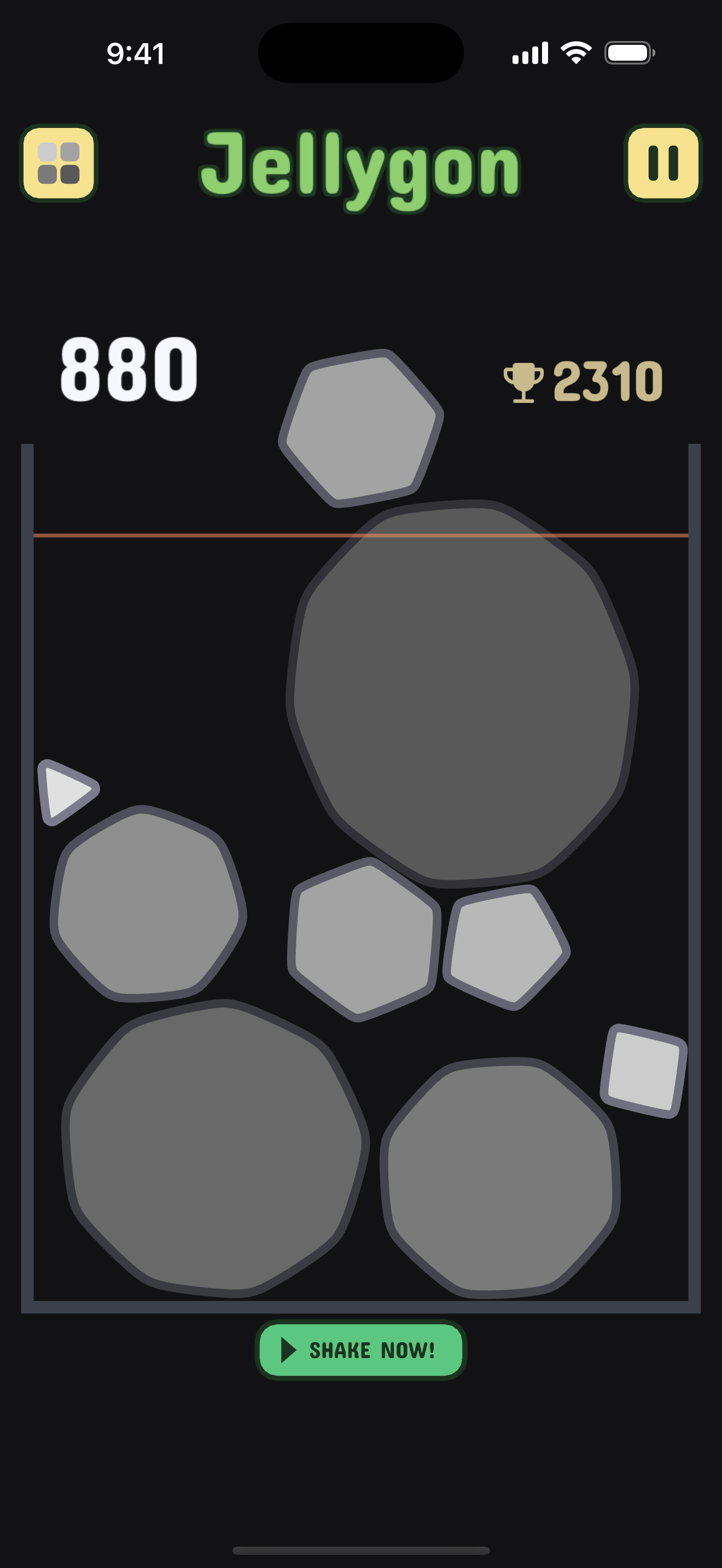
Drop-and-merge games usually become difficult in the same quiet way. A few harmless pieces land in the wrong places, the useful matches disappear under the pile, and suddenly every drop has to rescue the last one. Jellygon makes that mess less predictable because its pieces do not stack like coins. They bend around one another, settle into gaps, and occasionally shove a neighbor exactly where you did not want it to go.
That makes tidy advice suspect. Keep the biggest piece in a corner. Build a clean progression. Never waste a drop. Each rule sounds sensible until a piece bounces, opens a gap, and triggers a merge that no tidy diagram predicted.
To see which habits survived more than one lucky cascade, we gave five simple automated players the same 50 piece sequences. Each played until it reached the final shape or overflowed the cup: 250 complete games. The clearest result was also the simplest. If you can reach a matching piece, aim for it. The test did not crown a grand system for organizing the rest of the board.
Five play styles, the same 50 sequences
The automated players were deliberately simple. They did not plan several pieces ahead or learn from previous games. Each saw the held shape and the current board, chose a horizontal position, and dropped.
| Play style | What it does |
|---|---|
| Greedy | Targets the highest matching shape on the board. With no match, it parks pieces in size-based slots. |
| Flat | Targets the lowest matching shape it can reach. With no match, it places away from the largest late-game shape. |
| Noisy | Uses greedy targeting with moderate random aim error, approximating an imprecise finger. |
| Split | Targets a match when one exists; otherwise sends even and odd tiers toward opposite sides. |
| Random | Picks a uniformly random horizontal position for every drop. |
Every play style saw the same 50 sequences. None used Jellygon's Shake rescue, so the comparison isolates placement rather than every choice available to a human player.
A reachable match bought about eight more drops
| Play style | Wins | Avg. score | Avg. drops | Reached tier 7 or 8 |
|---|---|---|---|---|
| Flat | 4/50 | 712 | 72 | 43/50 |
| Greedy | 3/50 | 706 | 72 | 41/50 |
| Split | 2/50 | 708 | 72 | 43/50 |
| Noisy | 2/50 | 695 | 72 | 43/50 |
| Random | 1/50 | 538 | 64 | 22/50 |
All four match-targeting play styles lasted an average of 72 drops. Random placement lasted 64. The score gap was larger: 695–712 for the targeted group against 538 for random, a difference of roughly 30 percent.
The late-game distribution shows the same split. Between 82 and 86 percent of the targeted runs reached tier 7 or the final tier 8. Random placement reached one of those tiers in 44 percent of its runs.
That is enough separation to be useful. A direct merge does more than score points: two pieces become one. In a crowded cup, completing a reachable merge immediately is usually better than adding another disconnected piece and hoping the board solves itself later.
The targeted systems finished effectively tied
Flat won four games, greedy won three, and noisy and split won two each. With only 50 games per strategy and a rare win condition, those counts are too small to rank them. One additional favorable sequence would move a strategy several percentage points.
Their other results barely moved. All four averaged 72 drops. Thirteen points separated the best and worst average scores in the group. Each reached tier 7 or 8 on at least 41 of 50 sequences.
Several attractive strategy claims live inside those tiny differences. This run does not show that the lowest reachable match is better than the highest one. It does not show that splitting tiers between two sides beats size-based slots. It does not show that precise aim beats a little error. The players tried those ideas differently and arrived at nearly the same place.
Random placement still won once
Random placement produced the weakest average board and still reached the final shape on one sequence. Physics occasionally rescues disorder with a ridiculous cascade. That is part of why the game remains interesting after its one-line rule is understood.
It is also a warning about learning from one good run. A chaotic system can work spectacularly once while performing poorly across 50 games. Strategy shows up in the distribution, not the highlight.
Moderate aim error did not ruin the noisy player's results. It finished inside the same narrow band as the other targeted strategies. That does not make missing beneficial; it shows that a slightly imperfect drop can still leave a workable board.
What to try in your next game
Finish reachable merges
The strongest result is the gap between every match-targeting strategy and random placement. Leaving matching shapes disconnected costs space and shortens the run.
Treat elaborate board systems as preferences
Lowest match, highest match, side splitting, and moderate aim error all produced similar results here. A system can help you make consistent choices, but this experiment does not identify a superior one.
Judge a strategy across games
Random play won a game. Flat play lost 46. One memorable cascade says little about the underlying odds.
Expect the final step to be the wall
Most targeted automated players reached tier 7; only 4–8 percent reached tier 8. Building the penultimate shape is common. Making the second one without overflowing remains the hard part.
Humans have advantages these automated players lack: lookahead, memory, an understanding of which shapes are buried, and a Shake when the pile needs another chance. These numbers test simple placement habits. They are not a ceiling on human play.
For the next game, the evidence supports a compact plan: take the reachable merge, use whatever board system helps you make that choice consistently, and do not mistake one lucky cascade for a repeatable strategy. The finer arguments can wait until the pile proves them necessary.