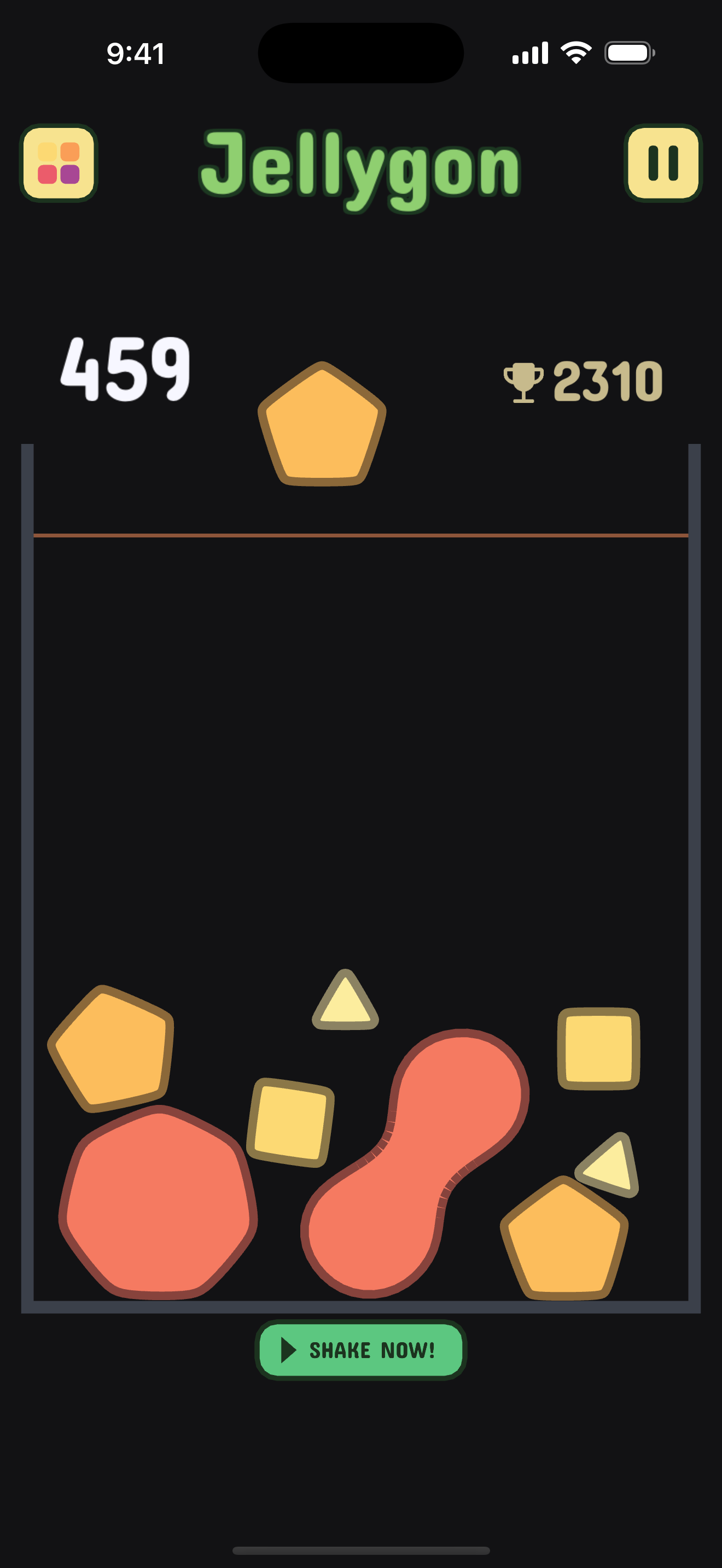
Most drop-and-merge games are built from rigid pieces. A fruit may roll or bounce, but it keeps the same outline while it moves. Once you understand its size, you can make a decent guess about where it will fit.
Jellygon uses soft polygon bodies instead. The first piece is a triangle, each tier adds another side, and matching shapes merge until two decagons create the final hendecagon burst. Every piece can bend under the weight of the pile.
That sounds like a visual change. It is really a change to the puzzle.
Aiming chooses the first collision, not the final position
With a rigid circle, the drop point and the resting place are usually close relatives. The piece falls, rolls along a predictable surface, and stops when the forces balance.
A soft piece can change the surface while it lands. It may flatten against a large shape, curl into an opening, or push a neighbor aside before it settles. The place you tap still matters, but it starts a small negotiation with the pile rather than choosing an exact destination.
This is why two similar-looking drops can finish differently. A gap may accept one corner of a polygon, reject the next, or close while the surrounding pieces relax. The board has a short memory of everything that just hit it.
Empty space has a shape
On a tile board, empty space is easy to count. In a rigid-body merge game, it is less tidy but still mostly geometric: compare the opening with the size of the incoming piece.
Soft bodies make the answer depend on pressure. A narrow opening can be useful if the piece above it will yield. A larger opening can be useless if the surrounding jellies are already braced against the walls. The question is not only “does this fit?” It is “what has to move for this to fit, and where will that movement go?”
That distinction becomes more important late in a run. Small shapes disappear into creases. Large shapes flatten across the cup and create shelves. A board with plenty of visible air can still have nowhere safe for the next piece.
A merge rearranges more than the matching pair
Two matching Jellygon pieces fuse when they touch. The new polygon reforms in the space they occupied, but the surrounding pile does not politely wait for it. Neighbors shift, compressed pieces push back, and a merge near the bottom can travel upward as motion.
Sometimes that produces the ideal chain: one merge opens contact for the next, the pile sinks, and several bad decisions are forgiven in quick succession. Sometimes the same movement lifts an unrelated shape toward the overflow line. The celebration and the warning can be the same wobble.
This is the most important difference from a purely visual jelly effect. The deformation is part of the board state. It changes which pieces can touch and what happens elsewhere when they do.
Soft does not mean random
The pile is lively, but placement still matters. We compared five simple play styles across 250 automated games. Four aimed for reachable matches and one dropped at random horizontal positions.
Every match-targeting style lasted an average of 72 drops. Random placement lasted 64 and scored roughly 30 percent lower. The four more deliberate board systems finished close together, which suggests a useful order of operations: take the available merge first, then worry about whether your preferred layout is theoretically perfect.
There is still room for luck. Random placement reached the final shape once. Physics will occasionally pull a clean cascade out of a board that deserved no such kindness. Across many games, though, the deliberate approaches held up better.
Shake turns the pile itself into a move
Jellygon also lets the player Shake a crowded board. The pieces jostle, settle, and sometimes expose contacts that were buried. Reaching the final shape earns another Shake.
The interesting part is not that the screen moves. It is that the same pieces return in a different arrangement. A rigid shuffle usually relocates objects; a soft-body shuffle also changes how they press against one another. A shape that was acting like a lid may fold into the pile. A trapped smaller piece may finally touch its match—or become even more trapped, because the pile is under no obligation to respect the plan.
Shake is a rescue, not a reset. The inventory and the crowded cup remain. What changes is the network of contacts.
What to watch while playing
The useful information is visible once you know where to look:
- Pressure against the walls. A large piece pressed across the cup is less willing to make room than one resting loosely on the pile.
- Small shapes under shelves. They occupy little area but can keep two larger matching pieces apart.
- Movement below the surface. A low merge can lift the top of the pile even when it creates space overall.
- Reachable contacts. A direct merge removes a piece from the board. Across our 250-game comparison, that simple habit mattered more than the competing systems for arranging everything else.
Soft-body physics makes the board less exact, but it also makes it more expressive. A rigid piece tells you where it is. A jelly piece tells you where it is, what it is leaning on, and how unhappy it may be about the arrangement. That last part is usually where the next move lives.